
Graham Swon © Joffrey Speno
Your film is set in a specific time and place —the American Midwest in 1939—yet it feels as though it could be set anywhere and at any time. Beyond the reference to the real life prodigy Barbara, were there other reasons for choosing this historical and geographical setting?
Very often the reasons behind things are intuitive. While I was working on the first elements of the script, I was thinking about the late 1930s, and the melodramas of that era and the proceeding decades. The story set itself there and I followed.
1939 is a moment of extreme change, not only in the United States but everywhere – industrialization is spreading rapidly and World War II is about to dramatically shift the political, economic and cultural status of the world. I wanted the historical state of the world to mirror that of the melodrama playing out: immense changes are about to occur for the characters. If they are good, bad or neutral I leave up to the viewers interpretation.
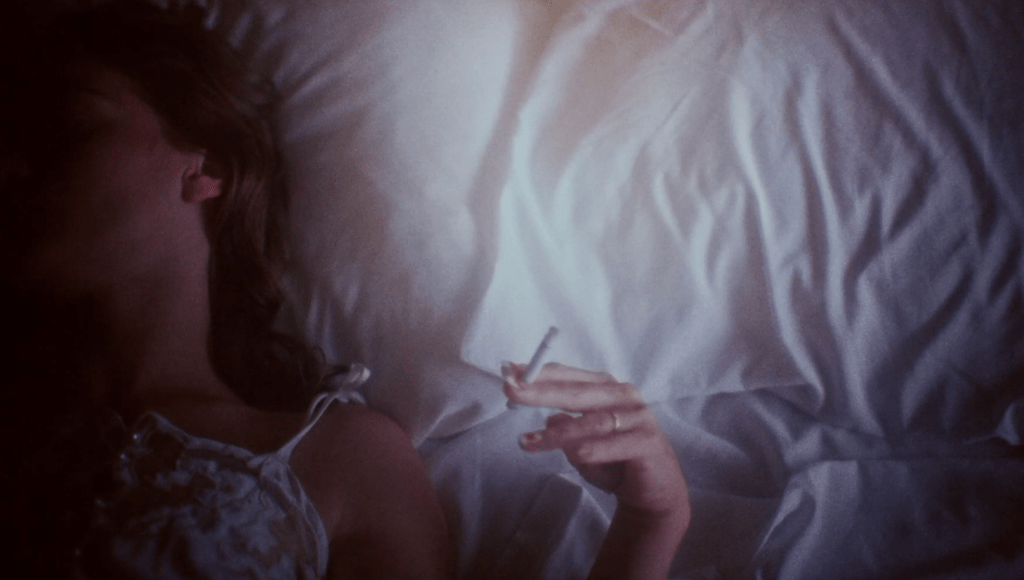
An Evening Song (for three voices)
The film has a distinct, dreamlike aesthetic, characterized by its soft imagery. Could you explain the techniques you used to achieve this look?
An Evening Song was shot using a camera divised by myself and the cinematographer Barton Cortright. We used as the basis a 4×5 photographic viewcamera, which functions without a mirror and instead projects the image onto a large sheet of ground glass for focusing and composition. From the first time I used one of these cameras, I was enchanted by the appearance of the image on the glass – sharp but soft, ghostly, with pastel colors and the texture of the glass built into the image. Normally no photographs one takes with such a camera would have these qualities as they come from the glass rather than the negative – but we rigged it in such a way that we could record the images directly off of the glass using a digital cinema camera. The effect is then capture entirely in camera, and is not the result of later digital manipulation. I am very happy with the resulting image, which feels somehow antique, even if it couldn’t have been produced without modern digital technology.
The main title of the film, containing the word “song,” and the subtitle “three voices” both carry strong musical connotations. While the film doesn’t involve literal singing, we experience the stream of consciousness of the three characters. Could you elaborate on the idea behind this concept?
The title, An Evening Song, is derived from the English term “Evensong,” which is a term in some Christian denominations for a sung prayer at sunset. I chose this title because it seemed to resonate with the themes and style throughout the piece; Martha’s religiousity, the disappearance of animals, the disappearance of Barbara. The “for three voices” subtitle is both to emphasize the entire piece as a composition and to nod to the intertwining narrators.
All cinema is musical, in that it deals with time and rhythm, silence and sound. In cinema there is also the importance of image and non-image: I was always very struck by a discussion in Amos Vogel’s book Film as a Subversive Art (1974) when he discusses the importance of the imperceptable darkness between frames when a film is projected, and compares it to the importance of the silence between notes in a musical composition.
How do you perceive the connection between cinema and literature in general? What do these two art forms mean to you, both together and separately?
Cinema is in many ways a composite art form – it’s qualities are unique but are derived from a combination of elements from many other art forms (photography, theater, literature, music). Of course, such a thing as ‘pure’ cinema exists, but it is not usually what we mean when we talk about the form. I was interested in exploring voice over and trying to use it in a more literary way – that is, conveying the internal life and point of view of each character, rather than merely utililzing it as a device to move the plot forward. Cinema is still a young art form, and I think many new ideas can be developed by learning from the long histories of literature, music and visual art. Personally, I find these art forms just as influentional as cinema on my work.
As a filmmaker, but I am continually amazed and often jealous of novelists. Their limitations are merely their own imagination, skill and time, whereas a film is confined by many physical elements (not the least of which is always money).

An Evening Song (for three voices)
Your film will soon meet the audience in Istanbul, at one of the city’s most prominent cinema halls. How do you feel?
Very good! I am always so happy when people can see the film in a cinema – this is how it was designed to be shown. I am always sad that so many viewers will be confined to seeing the film on a laptop or television. An Evening Song is designed to envelope the viewer, and a large projection with surround sound is necessary for it to have it’s full effect.
Thanks for all your answers, see you soon in Istanbul
Interview: Matthias Kyska, Enes Serenli



 Othon Cinema