As Othon Cinema, we are very pleased to interview Helena Wittmann, whose films we admire, and to present her first interview in Turkish to our readers. Wittmann, especially with her last two feature films Drift and Human Flowers of Flesh, presents a cinema that should be explored and talked about a lot. We feel very lucky to be able to ask her questions about her cinema, which occupies our minds with great care, and to be able to talk about it, and we would like to thank Helena Wittmann for answering all our questions with great care and Keda Bakış for translating this interview in our own language.

Welcome! Thank you very much for kindly accepting our invitation to this interview. First of all, how’s life going for you nowadays?
Thanks for inviting me! Well, it’s a very sad moment, as we are facing ever new wars and accelerating polarisations, a climax of stating, judging, taking sides – as if the world could ever be seen like that, in binaries. As if the division of world into binaries itself didn’t play a big role in the dynamics that lead to all these disasters. The division in the cultural world frightens me and I hope that people will start to listen again, to be sensitive with each other. And not to see this sensitivity as a weakness.
Can we say that your cinema has reached a wider audience with your last film, Human Flowers of Flesh? If you think so too, what is the impact of this situation on your life and cinema? Also, do you think your films reach the audience you want?
I am not so sure if it really reached a wider audience. DRIFT was shown a lot over the last years, but, of course, with a second feature film, you already have people who wait for the new film. And Human Flowers of Flesh had theatrical releases in a few countries. Anyway, this didn’t change my life or my views on cinema. It is more important to see how each work gives way to the next. It’s a process, a continuous process of learning and opening.

Human Flowers of Flesh (2022)
Could you talk about your creative process when you develop a film – do you start with a concept and try to establish a visual world accordingly or do you first create images and derive a concept out of it?
My films emerge from the life I am living, and making films and cinema are a big part of it. It is never an idea or a concept, nor a visual world that starts a process. A conversation, a song, a story – The first steps are usually based on concrete observations, places, people and, of course: questions. If they linger, and if at least two elements start to resonate with each other, it can make room for a possible film.
You use wordless images rather than dialogues to create meaning. Are you choosing this option because it aligns with your formal preferences in cinema or because it best conveys what you want to express?
It is my way of understanding. And it includes all my senses. I try to focus, to come to the point. Anything unnecessary has to make way for the substantial (for the film, of course). I love words and language. But for me, it is not the primary way to understand my surroundings and that’s why it’s not a primary element in my films either. It is one element among other cinematic elements.
Throughout the history of cinema, much has been discussed and conveyed regarding the significance of spatial elements within the medium. When we look at your films, it is obvious that you have thought a lot about this subject. For you, what exactly is the importance of creating a cinematic space in your films?
It is true that I thought a lot about it, but it was not the first thing to do, I am really not an intellectual filmmaker in that sense, even if I enjoy thinking a lot. – I actually work very intuitively at first, being aware of the fact that all my knowledge influences intuition. I am not interested in concepts as a starting point, it feels already domesticated. In this sense I am really an experimental filmmaker. And about space and time: The very elemental point is that we exist in space and time, we move, we transform. And for me, cinema is all about that. A time based medium that works with spaces, and it is, of course, about movement.
We realize the place and importance of the ocean in your films. Rather than asking a specific question about it, I would like to ask what you feel about the ocean and what it means to you in your films.
I have different feelings towards the ocean, and it also means different things to me in my films. It’s not this one entity that can be grasped in a picture, a sentence, a soundscape. That is probably what draws my attention and fascination towards it. The ocean resists to be determined.
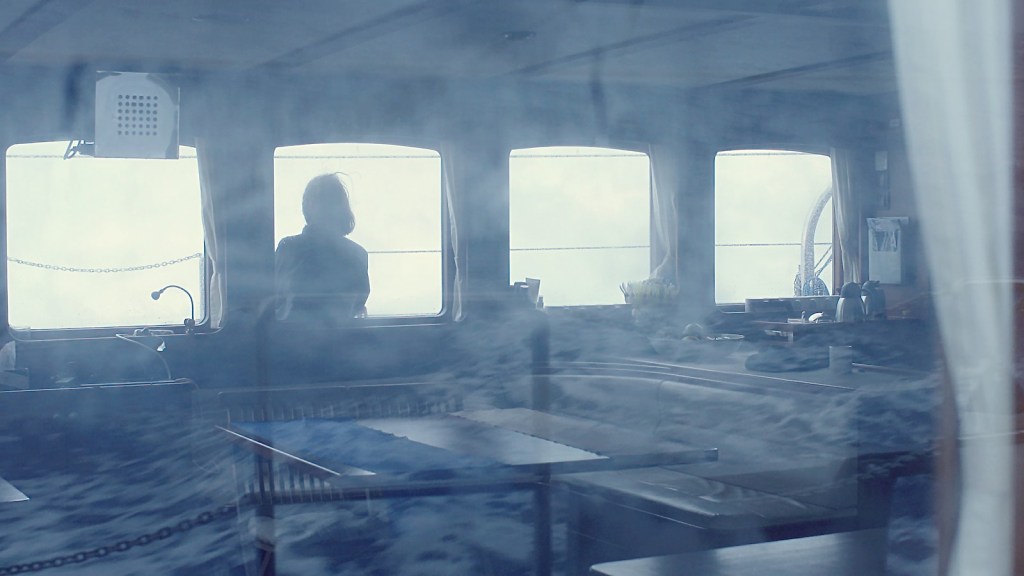
Drift (2017)
In both Drift and Human Flowers of Flesh, you beautifully bring the ocean to life as a character. I’m curious, how do you approach creating a character in films that feature something other than human beings?
Long time observing and listening. I see the ocean as something very alive, almost like an enormous animal, even though I know it is just my inability of understanding it, the ocean is much bigger than that and still very mysterious. The longer you are with it, the more mysterious it becomes. Like anyone you meet: after a first encounter it is very easy to describe a person, in a few words. But the better you get to know a person, the harder it gets to describe her/him/them, until it becomes impossible. Same goes for the ocean. To me, it is a real character, that’s why it has this principal role in my films.
In Drift there is a connection with Snow’s Wavelength and in Human Flowers of Flesh with Claire Denis’s Beau Travail. Could this have an effect similar to the intertextual connections in postmodern literature? Can films also build a new power for themselves through the influence of previous films?
I do believe so, yes. And it is really not about hommages or quoting, it only makes sense if something new emerges. And one more thing that is not directly answering the question, but somehow linked to it: I am actually curious to see more free spirited strategies of narration like, for example, in Melvilles Moby Dick or in Roberto Bolaño literature. I don’t know if it is my field to explore (who knows), but I would love to see something like this in cinema! (I am not talking about adaptations, I am talking about the form.)
The pervasive presence of a camera that ceaselessly observes its environment is a recurring motif in nearly all of your cinematic works. This technique imbues the camera with a sense of autonomy, as if it is crafting its own narrative. Would you be willing to expound upon the potency and persona of the camera in your oeuvre?
Well, I guess this perception is closely linked to the fact that I am doing the camera myself. It is my way of focusing on the very moment, a way to be present. And it is an important tool for me to come to an understanding. Finding the position, the distance, the framing – it is like thinking for me. And when I have made all the decisions, when it comes to the shooting itself, it becomes like touching whatever or whoever is in front of the camera.
In your films Later and 21.3°C, a parallel methodology is observed. The implementation of a stationary frame, accompanied by the passage of time, prompts contemplation on whether this stylistic choice embodies the essence of cinema. Additionally, could you elaborate on the factors you consider when establishing a frame and the meticulous process involved in crafting the composition for shooting?
As I mentioned before, it usually involves observation. In my experience there are not so many options to frame a location, a person, an object, if you are looking for a specific expression. But you have to find it out and that means you have to work on it. It’s not just about producing a „beautiful“ image – at least not as a goal in itself. In my case it includes usually a long phase of research. In this case research means to go to a location often, at different times of day or even year, sometimes with my analogue photo camera, sometimes with a microphone, sometimes with a notebook, and sometimes it is just my body and my mind visiting these places again and again. Until I have understood enough in order to make a decision on the image. But in the case of „Later“ it was a completely different situation. I was filming something else, then the fog came, I turned the camera towards the hill and followed my intuition to film it like this, without any thoughts or plans for a film. This also happens, both strategies go hand in hand.

21.3 °C (2014)
Sound design has a very important place in your films and perhaps even forms the atmospheric basis of your films. Is your perspective on the power of sound in cinema a situation that comes to life with the image, or can we say that it almost goes beyond the image?
I would say that it goes beyond the image. I really understand both layers as equally important. Not only in the final work, which is the film, but much longer before that. A sound can call my attention, the reason might be my interest in movement and transformation. In the sense that any sound is based on a movement that sets sound waves in motion, until they reach my ear to be then interpreted by my brain .. like tracing back something that had happened. Following this thought, sound can be seen like a witness of movement and of change. In the sound design, Nika Son (with whom I am working with for many years, she is an incredible musician and composer) and me are looking for a relation between sound and image that expands our perception into the depth, so yes, beyond the image.
There is a clear reference to Michael Snow’s Wavelength in your film Drift. Can you talk about the influence of Snow and experimental cinema in general on you?
Wavelength by Michael Snow was among the first experimental films I saw after I had discovered the existence of experimental cinema for myself, it was in my early 20es. (I grew up in the countryside and it was still the time before Youtube, it’s odd to say, but times were really, really different with regard to accessibility of (sub)culture.) I watched it on a DVD, the quality was, well, DVD-like. I still haven’t seen the film on a print – so, I guess, there’s still a lot to discover. When I watched it, everyone was talking about the different materials etc. Looking back, I would say that this was not what interested me most. What has influenced me the most was the understanding of passing time in relation to what was happening in the room that we trespass. Someone dies, but the camera moves forward, like time does. It just passes, there’s really nothing we can do about it. If you take this into account, it leads into a different direction than conventional narration. And therefore to a different way of storytelling. That interested me.
What advice would you give a young filmmaker who wants to make experimental films – should he or she try to imitate existing forms and modify them or rather aim to be free of influences?
It really doesn’t make sense to imitate experimental cinema, as it contradicts it. An experiment means you invent a set up without knowing what comes out of it. You want to find out, this is why you do it. If this is not the case, I would not speak of experimental filmmaking. It’s always a risk. There are of course many ways of experimenting and imitation can be part of it, but if you want to imitate, just because you like it and you want to call yourself an experimental filmmaker, well, that’s not very interesting. We are never ever free of influences, that’s not the point. Nothing to make us free from. Anyone of us is many, counted by the influences and beyond. But in the works that I appreciate, there is always a reason for the film to exist, and the reason is never that someone just wanted to make a film – in order to become a “filmmaker” or a “director“.
To write about experimental films is a very difficult task and some viewers prefer to have an emotional viewing experience rather than understanding an experimental film, do you think that films should be understood conceptually with the mind, next to the emotional experience?
I have no general opinion on that. For myself, and when I talk about films with friends, students or any audience, I prefer to talk about perceptions, very concrete aspects, and if we want to learn from it, in the case of an academic environment, for example, to find out together how this perception was created. I am not so much interested in a containment of a film, or conclusions. If a film invites to do so, it’s probably not a film that will stay with me for long.
What is it like for you to leave the audience with a transcendental experience? When you create a movie, there is a magical possibility for someone to stand in front of the screen and experience emotions that transcend the film itself. It could be the mesmerizing power of the ocean or simply the ability to immerse oneself in that very place. This meditative experience for the audience must be very valuable for a filmmaker, what do you think?
If it happens it is of course a beautiful experience. I make films in order to share and to create encounters. But the invitation in my films are subtle ones, there is no huge billboard that blinks in five colors and that leads you onto the fixed tracks of a rollercoaster, where you can then experience a controlled excitement. If you accept the invitation to let go in my films, you’ll find space for detours, there are many ways to experience it, it is meant to be like that. I am very happy if people find their ways to “inhabit“ my films.
Your interview will be published in Turkey for the first time which is quite exiciting for us! Lastly, if there is anything you want to tell to the audience in Turkey and the readers of Othon Cinema, we would love to hear that.
I want to thank you, for your interest, but above all, for your passion and dedication. Thank you for making thoughts and knowledge accessible for others and to share it so generously.
Thank you for all of your answer. It is very precious for us to have this interview with you. Farewell until another day that we can talk about cinema at length.
Interview: Enes Serenli, Mert Mustafa Babacan, Matthias Kyska
Translation: Keda Bakış


 Othon Cinema