Interview with Gerald Kargl

What was the original motivation for making the film Angst, which is based on the story of the murderer Werner Kniesek?
At the time, I had made several short films, and together with Zbigniew Rybczynski—who worked on the screenplay for Angst and also did the cinematography—I had already made a short film featuring Franz Klammer. Another Polish cinematographer, Bodgan Dziworski, was also involved.
After those short films, I wanted to make a feature film. I wasn’t interested in doing something as political agitation, which was quite common in what was then called the young Austrian cinema of the 1970s and 80s. I wanted to do something dramatic—something that dealt with fundamental human matters. That’s when the Kniesek case came up. A man who, just a few weeks before his final release, was granted a temporary leave from prison to take care of personal matters relating to his upcoming release—and used that opportunity to wipe out an entire family. No specific targets, just random victims. It could have happened to anyone.
The crime sparked a huge political scandal. The socialdemocratic government at the time was accused of having gone too far with its liberal justice reforms. Although that wasn’t the actual cause of the crime. It’s likely that Kniesek would have committed the crime even after his final release—but the fact that he took the very first chance available to him shows the pressure he must have been under during his years in prison. And that he had to have hidden all of this from the guards, the psychologist, and so on. That aspect intrigued me—the psychology behind it. It was fitting for a dramatic story. Not a political statement, but entertainment—with an interest in deeper reflection. The voice-over commentary offers some insights into that.

Can you say something about the film’s aesthetics and film technique, and why those formal decisions were made?
The film’s aesthetics emerged through the camerawork of Zbigniew Rybczynski. He came up with various suggestions. For example, we mounted a mirror in front of the camera. The camera didn’t film the scene directly but rather its reflection in the mirror. This expanded the space, because the mirror shifted the camera’s focal point behind the mirror. As a result, the camera took on virtual positions—it filmed from viewpoints where it physically couldn’t be.
For instance, in the prison scene, it appears to shoot from below the floor, as if through the tiles. Or in other scenes later in the house, it sometimes seems to be filming from behind a wall inside a room.
“Angst” has an incredibly intense atmosphere—eerie, alienating, melancholic. The music by Klaus Schulze contributes to that as well. How did this collaboration come about, and what role does the music play?
Yes, many people find the choice of Klaus Schulze surprising. I couldn’t imagine using a traditional Austrian film composer—back then, I didn’t think there really was such a figure in Austria. A “god” like Bernard Herrmann would’ve been a dream, of course, but completely out of reach.
At the time, I was mostly listening to electronic and electroacoustic music. And there was this track on Klaus Schulze’s album X that had something mysterious, hypnotic about it. I thought, that fits. So I contacted Klaus when he was in Vienna giving a concert. He was interested, watched the rough cut, and was immediately enthusiastic. He said Angst would become a cult film. He had the better instinct there—because I wasn’t thinking about anything like that at the time.
So we met shortly afterward in Munich, when he was playing a concert there as part of his tour. We developed the soundtrack starting from that track. Klaus was—well, he’s sadly passed away now—but he was very easygoing. We recorded the entire score in just two days. That mysterious and hypnotic quality remained.
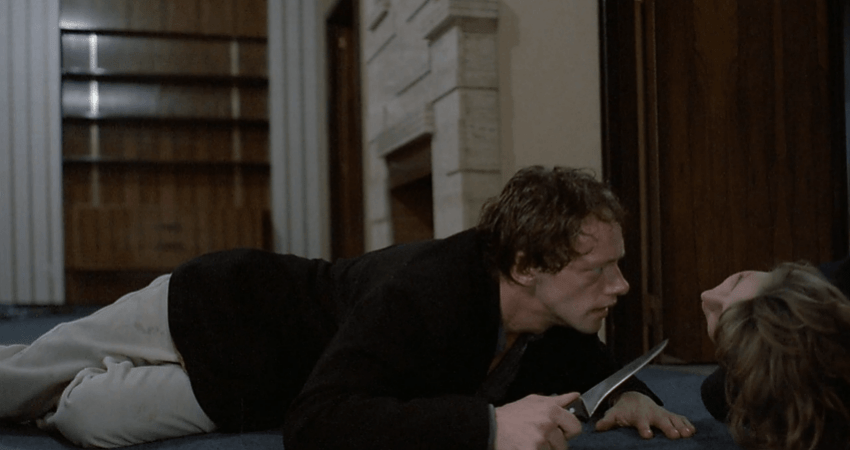
The film faced censorship immediately after its release. Over the years, it slowly gained cult status—partly through festival screenings. Directors like Gaspar Noé speak very highly of it. How did you, as director/producer, experience the long span of time from the film’s release until today?
I financed the film myself. Back then, there wasn’t any film funding in Austria like there is today. There was a small budget at the Ministry of Education at the time, and I tried to get some money from there—but without success. When the film was finished, I was deeply in debt. I was lucky to get a foothold in the advertising industry very quickly after Angst, and I was able to earn the money back and pay off all the debts.
That the international splatter community eventually discovered the film was never the goal. I don’t see the film as a splatter movie. The fact that it’s considered an art film today—well, times change. When the film premiered in 1983, people in Austria, at the very least, turned up their noses. That harmed me and made it more difficult for me to finance another film.
Although I was able to work continuously despite my outsider status—I made around 80 commercials and later over 40 short and long documentaries—all of that went unnoticed internationally.
Thank you for all your answers.
Interview: Matthias Kyska



 Othon Cinema