Interview with Lucrecia Martel
On an unusually warm autumn morning in Vienna, we sat down with Lucrecia Martel, whose latest film “Nuestra Tierra” was screened at the 63rd Vienna International Film Festival following its premiere in Venice. Our conversation touched on her concept of time, the way she uses sound to make the invisible felt, and what it means to regard the camera as a curious creature.

In your films, sound is not only an element that creates atmosphere but also a layer that reveals the characters’ states of consciousness. When you establish the rhythm of a scene, do you prioritize sound or image?
The truth is that, when it comes to sound, I don’t really do anything different from other directors. What happens is that I start thinking about sound much earlier, even before writing the script, from very fundamental questions.
Sometimes people believe I do something special with sound in my films, but in fact, it’s simply that my way of thinking about cinema begins with sound. Just as there are directors who think through images or who have a visual concept of something, for me it’s the sonic structure that triggers my process, it’s what makes me start thinking about how to find a language for whatever it is I need to do. Sound, for me, is what allows me to think about things.
But really, it’s not that I do anything unusual in the sound design of the film itself; it’s something that happens earlier, even before I start writing, when I begin to think.
Our culture is so deeply rooted in the visual that I find it very helpful to think through sound materials, through the sonic, as a way of having new thoughts. This is because, in order to think — and to think something new — one must always break some structure.

La Ciénaga (2001)
In your framing, we often sense the presence of what is “invisible” — off-screen sounds, movements beyond the gaze. What does showing the “invisible”, and making it perceivable mean to you in life and in cinema?
When you think from sound, what you see in a film is only a small fragment of the whole sonic universe. So, it gives the impression that you’re doing something unusual with sound, but in reality, it’s simply that you’re seeing just a small portion of a much larger sonic world.
In your films, time is often felt as a state of “density” or “suspension”. How does the concept of “time” work in your aesthetic conception, and how do you manipulate it?
That comes from the same place. Because yes, the very idea of a timeline, the idea that events are organized along a line, is something that comes from visual thinking, from a visual concept of time, that arrow of time.
But if you think from sound, time isn’t a line, it’s a volume. And the events… it’s as if they were scattered within that volume. To visualize it somehow, it’s like having a number of events dispersed in space, and the way they connect, what we call cause and effect, becomes much more evidently arbitrary.
On a timeline, cause and effect appear inexorable: one thing happens before, another after, and that’s it. But if you conceive of time as a volume, the decision about what is cause and what is effect becomes much more arbitrary. That way of thinking reveals the intention of the one telling the story.
In the linear scheme, that intention disappears, it seems as if life simply is that way, as if it were natural. Whereas if you imagine time in a more spatial way, the order of events becomes more deliberate, and that allows you to denaturalize many things that society takes for granted. And these are small things, they don’t have to be grand events.
However, this also requires a great deal of patience from the viewer. Most viewers expect a linear plot development, but with your films, they are immersed in the film itself rather than following the plot.
Exactly.
In an interview you said that filmmakers should be “alive with what’s around them” rather than just focusing on references to other films and literature. However, it seems inevitable that filmmakers will work without reference. How can they balance this dilemma, and what exactly do you mean by being “alive with what’s around them”?
References from literature and cinema enrich us, of course, because they enrich our perception of the world. But it’s another thing to take the references or the language of one film and simply transfer them into another. That’s an empty act.
Because when you do that, what you’re really taking is what you perceive as someone’s form or style. And form, style — they’re nothing by themselves. It’s like admiring someone’s life, and to have that life, you decide to wear their clothes. It’s useless. It’s an empty gesture.
On the other hand, if you look for structures and for language in what surrounds you, that’s something saturated with meaning, full of layers. Of course, the spectator is educated into a certain way of perceiving — it would be foolish to deny that — and that way is, let’s say, rather hegemonic.
So when you make something —thinking of others, but also of yourself— you have to keep that education in mind. That’s why it’s important to study cinema: to understand what the structures of expectation are, what the spectator anticipates.
And all those expectations are tied to very traditional ways of building tension in narrative. But if you believe that’s not the best way to speak, not the best language, then you have to play with that, with those traditional forms and with other narrative forms and dose them carefully throughout the film.
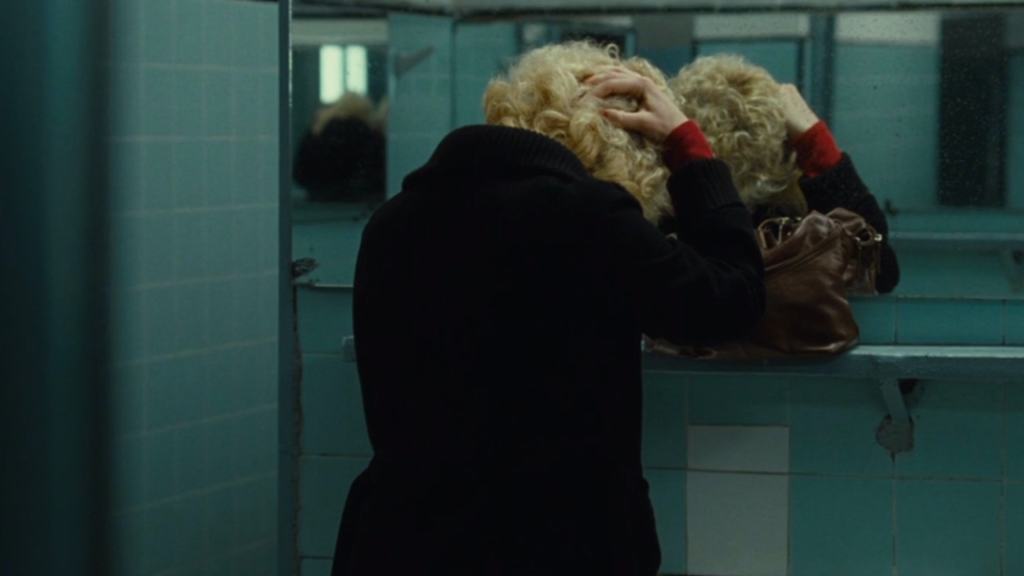
The Headless Woman (2008)
And how does your approach to fiction work? Most of your films are fictionalised. When you think about being aware of your surroundings in real life and in your country, how do you transform this into fiction?
I wouldn’t really know how to answer this, but what surrounds us, what exists around us, and what we believe about those things, that’s already a way of observing the world.
But beyond that, the world around us has been organized by successive layers of human beings who have decided how things should be, systems of value about what is good, what is bad, what is healthy, what is… proper. So, what one must do is to reveal that construction.
Cinema isn’t there to say “this is wrong” or “this is right,” but to show how things have been constructed. To show that things are not natural, to show that they are made, defined, by human beings.
This is an indirect approach that avoids being didactic when revealing facts.
Exactly, because that would be a big mistake. If I say, “This is a telephone,” everyone knows what that is. But if I say, “No, it’s not a telephone, it’s something else,” that doesn’t work, because I’m just replacing one thing with another.
But if I present it in such a way that, each time it’s used, the object reveals its own nature, its structure, its role, then I denaturalize the idea of “telephone.” And there are small ways to do that. Let’s say, in a film, it was necessary for an object not to appear as something natural, like a telephone, for instance.
Or, to take another complex example: in a romantic comedy, it’s almost never a problem whether someone has a house or doesn’t, has a job or doesn’t, because what matters is love, how people meet.
But when, in a romantic comedy, the problem isn’t only love but also having a job, having a place to live, the things people fear, the more complex that becomes, the less clear the romantic comedy might be, but the richer the world becomes.
These are very simple examples, but it’s so easy to watch films where everything is taken for granted, people always have jobs, they have homes to go back to, to sleep in. So many things are assumed as given that aren’t, in fact, true for everyone. There’s a huge part of humanity that has no work, that doesn’t even know what a bathroom is, and yet we act as if everyone has access to these things.
So, one has to find a language through which it becomes visible that none of these things come on their own, that none of them are natural givens.
In one of your interviews, you described the camera as something you place inside the scene like a person — a curious, non-judgmental presence. Is this position still the same regardless of the story, the characters, and the setting of the film, or does it change from one film to another?
It’s a way of being on set. When you place the camera, I don’t think of it as a device, nor do I think it’s me, nor something that isn’t me. Rather, it’s a kind of curiosity that’s present within the scene. For me, it’s like a creature, someone who is watching, who likes what she or he sees and wants to understand it, but doesn’t know what’s right or what’s wrong. It’s pure curiosity.

Zama (2017)
Could we also say that the camera is an innocent creature to you?
I’m not sure it’s innocence. Because if you say that curiosity is innocent — innocent of what crime? It’s an expression that comes to us from Christianity. But also from a kind of strange Christianity, because in Christianity we’re all sinners, that’s very clear in Catholic catechism. And yet, when we speak about very young people or about childhood, we say “innocent.” Innocent of what? Or guilty of what?
These are some of the traps our culture has built for itself. So that curiosity present on set helps me see better, it helps me find the frame. But it’s never: “now comes the close-up,” “now comes the wide shot.” It’s something that keeps moving.
That’s why it’s no use for me to draw the shots beforehand. I don’t know what will happen in that moment. It’s something that happens there, and you keep searching for it. I also know that I film very slowly, so I organize myself around that, I don’t shoot twenty takes a day.
Your camera movements are usually patient but always carry a sense of “waiting”. What kind of thinking lies behind these movements — does the camera follow the character’s inner rhythm, or the weight of the environment?
Yes, but actually, what I don’t like is when the camera already knows what’s going to happen. Let’s say you’re somewhere, and suddenly there’s a sound, something happens, but you’re looking in another direction.
For example, I’m looking at you, and over there an accident happens. But right now, what matters to me is you; I don’t care that there’s an accident, because there’s something I want to understand about you. I’m not like a frantic person trying to see everything at once. So maybe I’m looking at you, and suddenly a car wheel passes in front of us, through the frame, but my attention is still on you, not on everything that’s happening around us.
So, for instance, if I’m filming a conversation between two characters, and I know a character is about to enter, why would I move the camera toward the door exactly at the moment they enter? What a coincidence, right?
Maybe I’ve heard something and I’m waiting for someone to come, but when I turn toward the door, maybe it stays closed for a few seconds. And while the door is closed, and I’ve stopped looking at you, now there is tension, because I’m looking somewhere else. Of course, as the two characters are talking, I film both of them, and at some point, I turn to the door. The two characters keep talking, but I’m filming the door. And that’s where tension appears. What’s happening? And then, after a few seconds, someone opens the door.
That’s very different from cutting right to the door as it opens and the character enters. It’s completely different, because with the camera, you can either do what you already know is in the script, or you can wait for things to happen. You can anticipate or you can wait. And what’s interesting about sound is that it lets you be calmer, to look at people or at things without anxiety. Things happen, at some point they’ll pass in front of the camera, or maybe they won’t. And that creates a completely different feeling for the spectator.
When you watch a scene conceived that way, the sensation is very different, you feel that everything is calmer, even though it might not be. Maybe a lot of things are happening simultaneously, only the camera isn’t frantic.
There were rumors that after “Zama” you also wanted to adapt Antonio di Benedetto’s novels “El silenciero” and “Las suicidas” for the screen. Are you working on these projects?
No, it was already filmed by another Argentine director, and honestly, I don’t think I’d be interested in doing an adaptation in the future. But I would like to make a science fiction film — that’s something I am thinking about.
You were offered the opportunity to direct the Marvel film “The Black Widow”.
They didn’t pick me. (laughs)
It would have increased your salary. (laughs)
Yes, but I wasn’t hired by Marvel. But my idea was good. And then when I saw “The Black Widow” made by a different director, I thought, “What a pity. My idea was better.”
Thank you so much for all your answers.
Interview: Matthias Kyska



 Othon Cinema