Interview with Christian Petzold
During the 63rd Viennale International Film Festival, we sat down with Christian Petzold, who became the festival’s president earlier this year, coinciding with the screening of his latest film “Miroirs No. 3” as the festival’s opening title. In our conversation, Petzold spoke about what it means to be a cinephile while making films, how genre can offer the greatest freedom, and why the characters in his films are both ourselves and not.

Welcome… It’s well known that you’re a passionate cinephile and have seen countless films — we know that very well from your mentor-student relationship with Harun Farocki as well as from your interviews. Has that continued to this day? And to what extent does your own film viewing influence your work as a director?
Yes, I have to say that Harun Farocki and I often took existing films as a starting point — to make them again, only differently. That has to do with the fact that we both loved Howard Hawks very much — and Hawks himself sometimes shot some of his films two or three times, filming the same scripts more than once. Each time, the film was a little different, and that “little different” was an entire world.
I still remember walking with Harun one day and asking him: Is there actually a film in the history of American cinema that tells the story of class struggle — the struggle of the working class? To my surprise, Farocki replied: James M. Cain, The Postman Always Rings Twice.
Then we thought about all the versions that had been made: in the 1940s by Tay Garnett, later by Visconti, and again in the 1980s with Jack Nicholson. It seemed to be a story that had to be filmed again and again — just like “Invasion of the Body Snatchers”. That film, too, was reinterpreted several times: in one version, the communists were infecting Americans’ brains; later — in the Donald Sutherland version — it seemed as if the state itself was infecting people and taking away their freedom.
It was similar with James M. Cain’s story. We talked about it for a long time, until I finally said: You know, for me, there’s something in Cain’s original text that none of the previous film versions have really dealt with — namely, racism.
Because it’s always the same core: a Greek man who has married a beautiful white American woman, and a poor American man who wants to kill that rich Greek in order to get the woman. That’s a racist motif. Racists and fascists say: “The foreigners are taking our women away.” That’s exactly what’s at the heart of that story.
From there we developed the idea further and imagined the following: There’s a Turkish migrant named Ali. He owns three small restaurants, he’s a successful businessman, and he meets a beautiful but indebted blonde German woman. He marries her and pays off her debts. In doing so, he’s buying himself Germany — a blonde woman, a German house, a fantastic German car. Then he meets a poor German man and “buys” himself a German friend. He wants to become German, to achieve complete assimilation. At the same time, he brings to Germany a vitality, an entrepreneurial spirit, a life energy that the Germans have lost. And that’s exactly why they hate him. In the end, the two Germans kill him to get his money.
That’s the story of James M. Cain, and it was one of the foundations for my film “Jericho” (2008). What I’m trying to say is that film history and the mythology of cinema have always influenced my own filmmaking…

Christian Petzold ve Harun Farocki
Yes, as if there were these primal texts or archetypal films that can evolve anew within different cultural contexts.
Exactly, and that’s also how it was when Harun Farocki made a film about venture capital. It was called “Not Without Risk”, a film about the new capitalism. Harun conceived and shot that film, and I helped him a bit, sort of like an assistant. His goal was to find out whether this “new capitalist” really exists.
In the past, capitalists were people with cigars and gold chains. The new capitalists, by contrast, listen to Mozart and don’t drive Lamborghinis anymore, that’s what the hip-hoppers, the “primitives,” do now. The new capitalists play golf, they engage in culture and foundations. Harun was wondering whether one should portray this new type, what he looks like, how he acts, how he looks at things. In earlier times, people who dealt with money were the most boring people in the world. Everyone who studied business administration was the asshole in the class. Today, they present themselves as if they were people of culture. That’s exactly what Harun Farocki wanted to show.
During that time, I was thinking about the expression “dead capital.” Capital can flow anywhere. But there are places where capitalists meet — for example, near Frankfurt Airport, where there are entire hotels with conference rooms. Spaces entirely disconnected from the world.
That made me think of Edgar Allan Poe’s story “The Masque of the Red Death”: The plague comes to Europe, and the rich build themselves a refuge where the pestilence cannot reach them. They hold a masquerade ball there, and among the guests appears someone wearing a red mask, the plague itself. It infects them all.
So I thought: I also have to make something about capitalism, like Harun, but as a horror story, a ghost story. And I remembered the film “Carnival of Souls” (1962) and the short story “An Occurrence at Owl Creek Bridge” (1890). In that little story, deserters are hanged on a bridge. One of them falls into the river as he’s being hanged and the rope snaps, and he manages to swim away. They shoot at him, but he reaches the shore. He wants to return to his wife and child, because he despises the war. He runs through the forest he knows, but it looks a bit different. He crosses a field that also looks a bit different, and then he sees his farm, his wife, his child. From behind, he calls out their names and at that moment he feels a sharp pain. Then the story ends with the sentence: “And then he was hanging at the bridge.”
That means we see the dream of a dying man in the moment of his death, not the life he has lived, but the one he has dreamed of, yet never reached.
I used that for the film “Yella” (2007). I combined the dialogues from Harun Farocki’s “Not Without Risk” with the horror story of a woman who wants to become a capitalist and in the moment of dying, dreams the life she always wished for, but as a nightmare. That’s how film history plays itself out in my films.
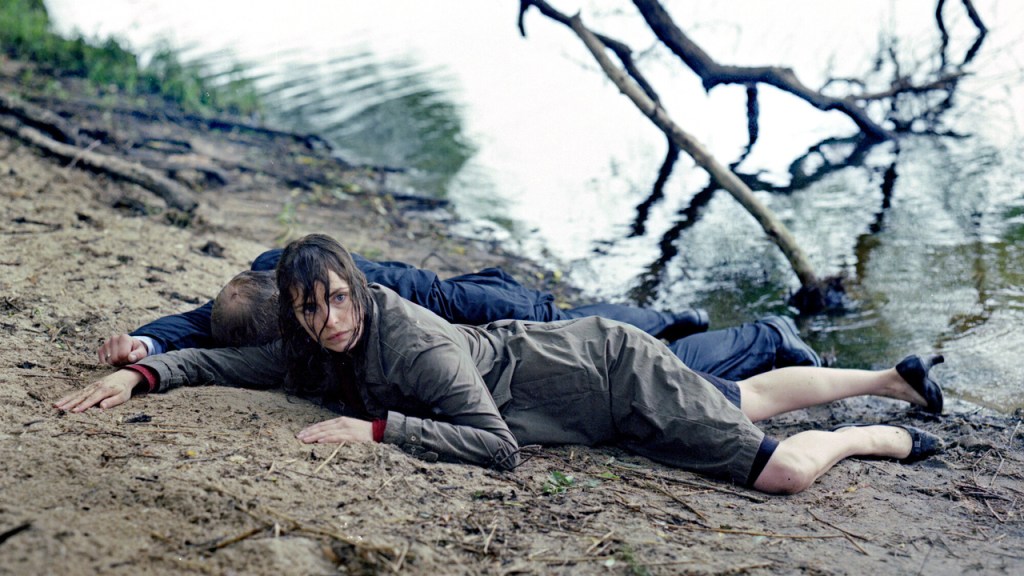
Yella (2007)
And was it the same with your later films — that there were reference texts or a reference film each time?
Yes, or sometimes several reference texts. Films don’t just come out of nowhere. They basically come from cinema — from literature too, of course, but primarily from cinema. I always show the actors a few weeks before shooting some films, photos, and music. Then we do rehearsals, which are actually more like seminars. And in those, I show them the films that served as references. Often, these films no longer have any direct connection to what I’m shooting at that moment — but the idea came into being through them.
So for you, filmmaking means always moving consciously within film history, recognizing certain texts or constellations and not starting from scratch.
No one starts from scratch. Anyone who writes a book has, after all, also read books. Films don’t simply arise in one’s head; they emerge from connections, from proximity. When directors say, “I already had it all in my head,” I don’t even want to see that film. That, to me, is the image of a 19th-century artist-subject: “Everything is within me; it just needs to come out.” Films arise within contexts.
What role does “genre” play for you in filmmaking? To what extent does genre influence the balance between free creativity and established codes? On one hand, genres can feel restrictive, since they predetermine certain characters, traits, aesthetics, and plot elements. On the other hand, they offer a tried-and-tested framework for a film. Some critics have said that while your films are oriented around certain genres, you tend to “purify” them, reducing them to a minimum.
Yes, the problem for us in Germany is that there are no German genres anymore. The fascists destroyed everything between 1933 and 1945. The only genre the Germans had left afterward was the Heimatfilm.
But genre means that there is a grammar, laws, a structure. Why can one watch a thousand Westerns in a row? To someone who doesn’t know much about them, they all look the same: a saloon, a sheriff’s office, a main street, dust, horses, a duel, a good guy, a bad guy. But genre requires grammatical intelligence, it’s the small differences that count.
Take horror films: a car drives down a road, the engine sounds strange, then it stalls. A shortcut, an old gas station, a guy with one tooth who says you can spend the night in a cabin out in the woods. And yet, it’s exactly those small differences that make the genre, even when you think you’ve seen it all before. The difference is the story. “Halloween” is a completely different film from the slashers that came before it.
That’s why I love genre, because it means freedom. Precisely because there are laws and sign systems, one is free. It’s restrictions that create freedom, you don’t have to reinvent everything from scratch. The freedom within a genre is an incredibly beautiful kind of freedom. The films that pretend to have invented everything anew are usually the most clichéd ones. And the so-called clichéd films within a genre are often the freest.
If I think, for example, of “The Evil Dead” by Sam Raimi, what he invented with so little money, how he rejuvenated the genre once again, that’s what I love about genre.
In Germany, however, where there are no genres anymore, my love and understanding of genre appear in my films only indirectly. My films aren’t genre films, but they know that genre exists.
If you look at the beginning of my last film “Afire”: a car with engine trouble, a shortcut through the forest, someone says, “I’ll go ahead, wait here.” The film knows it could be a horror film. It doesn’t become one, and yet, in the end, it does. That’s an awareness of genre.
You just have to avoid quoting the genre to the point where it becomes a caricature. I love genre, but I don’t make fun of it. I hate parodies. I respect genre, because it’s a great art.
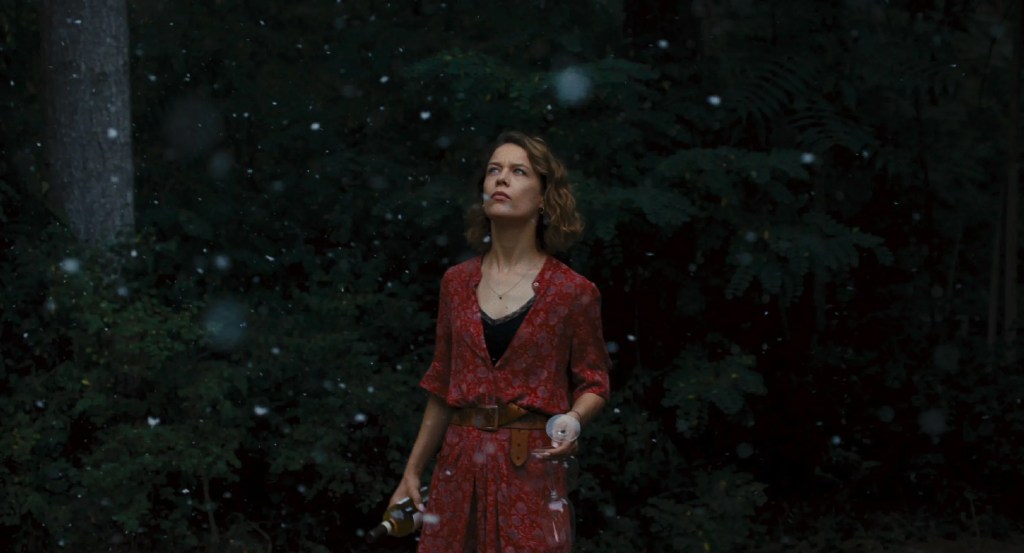
Afire (2023)
In an interview you once said, “I like that film characters can be both a part of us and far removed from us.” We don’t know to what extent you follow the audience’s reactions to your films, but many viewers — especially women — identify deeply with the female characters in your stories, with their love, emotions, and inner worlds.
That’s a bit of a variation on an idea from my teacher Hartmut Bitomsky, who wrote a book titled “The Redness of the Red of Technicolor”. In it, there’s a section about Burt Lancaster. In Don Siegel’s film “The Killers”, two hitmen are planning to kill “the Swede”, the character played by Lancaster. Someone hears about the plan, runs to Lancaster, and warns him: two killers are on their way to his home, he should flee quickly. But Lancaster is exhausted and says he can’t. Then you hear the killers’ footsteps on the stairs. Up to this moment, you haven’t even seen Burt Lancaster, he’s lying in the shadows, his face hidden. Only when he hears the footsteps does he sit up, and his face comes into view.
And Bitomsky writes this wonderful sentence about it: “It’s his face, but it also belongs to us.” I think that describes great actors: when they’re truly great, they belong to themselves and to us at the same time.
When, for example, Jennifer Lawrence in “Silver Linings” learns at the end that her repulsive, arrogant sister has suddenly entered the dance competition as her rival, a fury breaks out in her. She goes to the bar and drinks vodka to get drunk. The camera shows her in a wide shot as she storms angrily through the bar. In that moment, she is Jennifer Lawrence and at the same time, she’s the character. The character acts for herself, but also for us. That gives her a kind of sublimity.
And that usually doesn’t arise from technique, but from the context, from the way we look at her. The actress herself often doesn’t even know how good she is and that’s precisely when she’s at her best.
Does that mean that for you, casting is already important during the writing stage, that you already have in mind who will play the role later on?
Yes, just as I don’t believe that cinema originates in the head, I also don’t believe that you can simply write characters into a screenplay out of nothing. You need to have an image in mind so that the characters can emerge as something that doesn’t belong to you. You have to enter into a relationship with them, so that they don’t become too similar to yourself.
The moment I know that Nina Hoss, Paula Beer, or Franz Rogowski will play a role, I have to write the characters differently, they no longer belong to me. And that’s crucial: characters must not belong to you.
Before I write the screenplay, I first write a story. At that point, I don’t yet have any casting in mind. But when I start writing the script, I have to.
Thank you very much for all your answers.
Interview: Matthias Kyska



 Othon Cinema