The 83rd Venice Film Festival in the Shadow of a Single Film
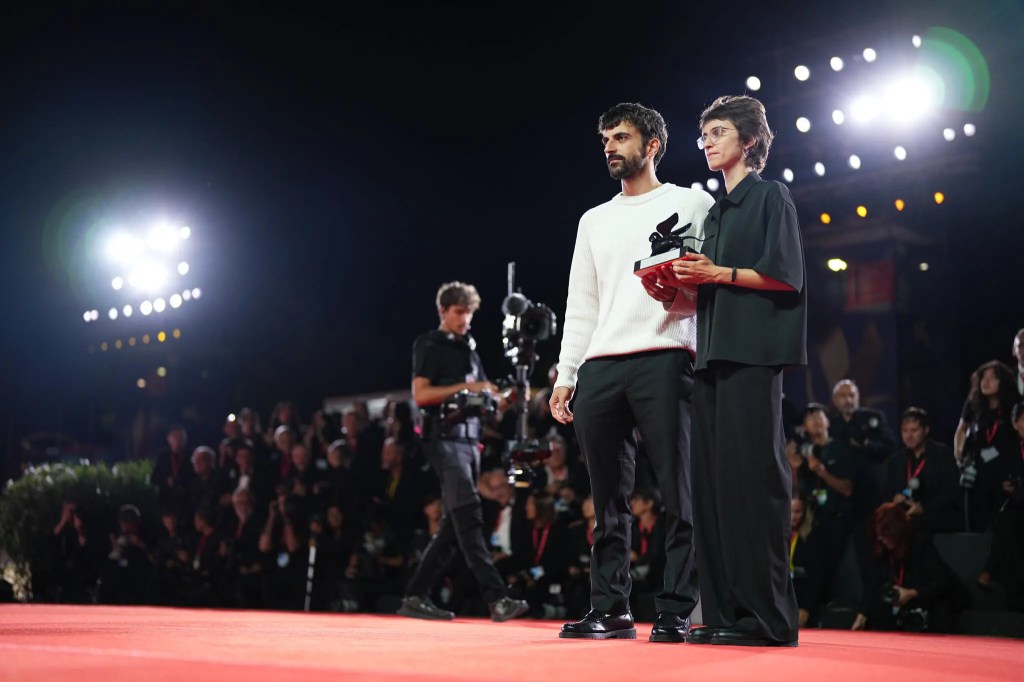
Rachel Szor, right, and Yuval Abraham, the film’s directors Naza, at the closing ceremony of the Venice Film Festival last week. Scott A Garfitt/Invision, via Associated Press
The main competition at the 83rd Venice Film Festival stands in the shadow of a single film, one that, by virtue of its subject matter and historical significance, can scarcely be compared with the other twenty films in competition.
Anyone writing about contemporary cinema is always faced with the same problem: there is no knowing which film will be forgotten within a few years and which will stand the test of time. This year, however, it is hardly an exaggeration to say that NAZA, by Yuval Abraham and Rachel Szor, is likely to endure as a historical document, a film future generations may turn to when attempting to systematically reckon with Israel’s conduct of the war in Gaza and the genocide.
The Israeli filmmakers Abraham and Szor were already among the four directors of the documentary No Other Land (2024), which chronicled the destruction of Palestinian communities through Israeli settlement and occupation policies in the West Bank. With “NAZA”, they now turn their attention to the war and genocide in Gaza. With almost forensic precision, the film examines the military and intelligence structures through which tens of thousands of Palestinian civilians have been killed since October 7, 2023.
What is crucial is the perspective. “NAZA” does not primarily recount events from the point of view of the victims. Instead, it gives a voice to people who were themselves part of the Israeli military and intelligence apparatus. Abraham and Szor interviewed 24 soldiers, officers and intelligence personnel, whose identities are fully protected. In considerable detail, they describe how, after October 7, a system gradually emerged in which the mass killing of civilians ceased to appear as an exception or an error and instead became a calculated component of military decision-making.
Particularly disturbing is the glimpse the film offers into the system of near-total surveillance in Gaza. The interviewees describe how enormous quantities of telephone, movement and communications data are collected and analysed on virtually every individual in the Gaza Strip, and how this data is then used, with the assistance of artificial intelligence, to identify potential targets for air strikes. Before an attack is carried out, calculations are made as to how many civilian deaths are deemed acceptable. The film refers to an anticipated “NAZA” figure of twenty civilians for certain strikes. One source even describes approval being granted to accept as many as 500 civilian casualties in order to kill a single Hamas member.
This is also where the film’s title comes from. NAZA is an acronym used within the Israeli military and intelligence apparatus to denote the expected number of civilian casualties from an attack — a bureaucratic cipher through which human lives are turned into a calculable quantity.
The calmness with which the interviewees recount all this is among the film’s most disturbing qualities. They describe a climate within the military and intelligence services in which the deaths of large numbers of civilians became normalised and dissent was not tolerated. Some even compare their work to computer games. The people who are killed thus become little more than instruments in the successful completion of a mission. Afterwards, one goes out for drinks with colleagues. This technological and bureaucratic distance from killing is not a secondary aspect of the film but one of its central subjects.
The film becomes especially harrowing when individual interviewees begin to articulate the moral significance of their own actions. One recalls studying the Holocaust and asking himself how ordinary people could become part of such a system. Now the same question turns back on him. Others openly speak of genocide, or of having participated in a system whose consequences they failed to question while they were part of it.
Formally, “NAZA” is all the more powerful because it does not show the destruction of Gaza in images. The interviews take place exclusively at night, on the rooftops of Tel Aviv. The faces of the informants remain in shadow, while behind them the lights of a modern, seemingly entirely normal city glow. The camera looks into apartments, onto streets and at television screens showing news broadcasts and speeches by Benjamin Netanyahu. Roughly sixty kilometres to the south, meanwhile, Gaza is being reduced to rubble.
This contrast produces some of the film’s most haunting images: here, the nocturnal calm of Tel Aviv; there, a genocide whose execution is in part organised from this very city.
One inevitably thinks of Claude Lanzmann’s “Shoah” (1985). Both films rely to a decisive degree on testimony and on the power of the spoken word, while consciously avoiding showing the horror in images. Decades after the fact, Lanzmann reconstructed the Nazi murder of Europe’s Jews through the accounts of survivors, witnesses and perpetrators. Abraham and Szor, by contrast, are documenting a system of mass killing while that system still exists and while the war their interviewees describe has not yet ended.
That is precisely where the devastating difference lies. “NAZA” is not a film that asks, in retrospect, how something could have happened. It asks that question at the very moment it is happening.
The fact that the Venice Film Festival chose not to relegate such a political and confrontational film to a sidebar or an out-of-competition slot, but instead selected it — as the only documentary — for the main competition is therefore significant. In doing so, the festival granted the film the same artistic and institutional status as the major fictional works competing for the festival’s principal prizes.
This decision appears particularly striking in comparison with the Berlinale of recent years. While the Berlin festival’s handling of Gaza has repeatedly been marked by political controversy, institutional defensiveness and the close relationship to Germany’s doctrine of Staatsräson, Venice gave a film that indicts Israeli warfare in the most radical terms the most prominent possible place in its programme. That programming decision alone carries political weight.
The jury could have amplified that significance further. Awarding “NAZA” the Golden Lion would have been far more than an aesthetic distinction. It would have given the film additional global visibility while sending an unmistakable political signal.
That did not happen. “NAZA” received the Special Jury Prize instead. Yet perhaps the film’s significance manifested itself more clearly elsewhere: in the nearly twenty-five minutes of applause following its premiere, and again in the audience’s reaction during the awards ceremony.
Most festival films will eventually either become part of film history or soon be forgotten. NAZA, by contrast, will become evidence for future generations.
The Silver Lion for Best Director went to Ilya Khrzhanovsky for “DAU”, a film that may mark the conclusion of his monumental DAU project. DAU is one of the most unusual cinematic experiments in recent film history. Between 2009 and 2011, Khrzhanovsky had a fictional reconstruction of a Soviet research institute built on a site of roughly 12,000 square metres in Kharkiv. Hundreds of professional and non-professional performers lived and worked there for years within this artificially created world, producing more than 700 hours of footage. Numerous standalone films have since been edited from this material, among them the six-hour “DAU. Degeneration” (2020), which premiered at the Berlinale and remains one of the project’s most outstanding works. The new three-and-a-half-hour film “DAU”, which premiered in Venice, returns the project to its central figure: the brilliant physicist Dau, loosely based on the Soviet Nobel laureate Lev Landau.
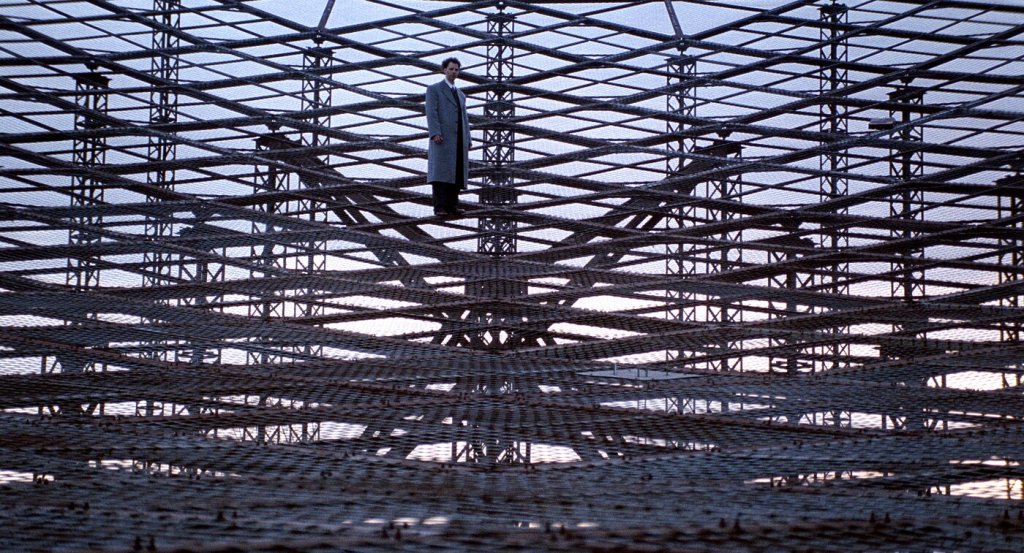
Dau (Ilya Khrzhanovsky)
The film follows him across four decades, from the late 1920s to the 1960s, while simultaneously tracing the relationship between scientific freedom and political power. Dau wants to understand the laws of the universe, but increasingly comes under pressure from a state determined to appropriate scientific knowledge for military purposes. His talents are placed in the service of the Soviet nuclear weapons programme, and his personal autonomy is curtailed step by step.
The initially independent and morally self-assured scientist gradually becomes a man who accommodates himself to the system. He increasingly tries to compensate for his lost freedom in private life: through sexual affairs, emotional detachment, and the attempt to preserve outside his marriage some remnant of the autonomy long denied him in his political and professional existence. In this respect, “DAU” also becomes the portrait of a man whose external accommodation slowly destroys his inner integrity.
Formally, the film is a veritable tour de force. The imposing sets do not feel like a historical reconstruction but like an actually existing world. A hypnotic montage allows decades of Soviet history to pass before the mind’s eye like fragments of memory. Again and again, the film produces images of almost apocalyptic force — scenes that resemble less conventional narrative cinema than gigantic, inhabitable art installations.
Compared with many of the other films in competition, “DAU” therefore stands out as an uncompromising artistic vision. One may find Khrzhanovsky’s method problematic, excessive or even megalomaniacal, but it is never arbitrary. The film possesses a formal and intellectual coherence that could only have emerged from a project that, for almost two decades, has resisted every conventional notion of how a film ought to be produced.
Hirokazu Koreeda’s new film “Look Back” is concerned not with highly gifted scientists but with two young manga artists. It is based on a manga by Tatsuki Fujimoto, which was already adapted as an anime in 2024. Koreeda’s live-action film tells the story of two girls who, while still in elementary school, develop extraordinary talent for drawing manga. One of them suffers from severe social anxiety and therefore does not attend school regularly, remaining entirely unknown to her classmate until the latter discovers her drawings and is forced to realise that she is facing a rival at least as talented as herself.
Although “Look Back” is not an anime, Koreeda’s visual language repeatedly approaches anime aesthetics. Compositions, movements and colours at times take on an almost hand-drawn quality, until, in one magical moment, the boundary between cinematic reality and animation appears to dissolve altogether.
At heart, however, “Look Back” is above all a warm-hearted film about artistic passion. It captures the exhilaration of two people who, despite their radically different personalities, work together, learn from one another and constantly strive to improve. Koreeda makes their almost obsessive joy in drawing, their ambition and their mutual encouragement so immediate that the energy of the two characters seems almost to transfer itself to the audience. With its warmth, lightness and emotional sincerity, “Look Back” is one of the brightest spots in this year’s competition.
Another film that already carries “light” in its title, by contrast, leaves a disappointing impression. Ali Asgari’s “A Bit of Light” attempts to capture the mood of everyday life in Iran under the country’s current state of political emergency. At its centre is a doctor whose practice is shut down and who, following his arrest, decides to take his own life.
What might have worked as a concentrated chamber piece instead becomes an excruciatingly static and overly schematic experience. The direction feels stiff, the dialogue is frequently declamatory, and the conflicts are asserted rather than dramatically developed. Instead of making political reality tangible through its characters and situations, the film too often merely illustrates its political statements. “A Bit of Light” thus remains so firmly bound to its historical moment that it gives little sense of being a film likely to outlast it.
One of the competition’s more idiosyncratic and at times enigmatic entries comes from Casey Affleck, who has once again moved from acting to directing. His new film “Company” resists easy classification, hovering somewhere between period drama, Western and vampire story.
Narratively, too, the film is unusually layered. A woman tells a story within which another story is told, creating three interlocking narrative levels. At its centre are motifs of hospitality toward a stranger, revenge, guilt and the possibility of forgiveness. Affleck is less interested in a straightforward plot than in the ways stories are retold, altered and remembered.
The performances are consistently strong, as is the film’s atmospheric evocation of the social conditions and living circumstances of the period it depicts. Yet despite its formal ambitions, “Company” never quite coheres into a convincing whole. Its different narrative levels, genres and motifs frequently sit alongside one another rather than reinforcing each other. The result is a film that fascinates in individual moments but, taken as a whole, remains oddly fragmented and difficult to grasp.
Florian Zeller’s “Bunker” also boasts a high-profile cast, with Javier Bardem and Penélope Cruz playing a wealthy married couple. The film, however, falls well short of the precision and emotional force of Zeller’s “The Father” (2020).
“Bunker” charts the gradual disintegration of a marriage whose tensions have long been simmering beneath the surface. Much remains unspoken, emerging instead in glances, evasions and seemingly casual remarks. This play with what is left unsaid initially belongs to the film’s stronger qualities.
The title carries a double meaning. On a literal level, there is an actual bunker that Bardem’s character, an architect, has been commissioned to design for an American tech billionaire. The project increasingly intensifies the tensions with his wife. At the same time, however, the bunker serves as a metaphor for the couple’s life itself: they have long since withdrawn into a world of wealth and privilege that insulates them from London’s precarious social reality.
With performers such as Bardem and Cruz, there is naturally little danger of the acting going seriously wrong, and both lend even weaker scenes a certain intensity. The larger problem lies in the screenplay. Some of the conflicts feel too visibly engineered, the metaphors are increasingly spelled out, and toward the end the film loses the restraint that had made it initially interesting.
Among the weakest films in this year’s competition are the Italian film “The Spiral” and the French entry “A Good Little Soldier.”
“The Spiral” is an overly blunt thriller that repeatedly reaches for violence and excess in an attempt to generate impact, without ever producing genuine suspense. The screenplay feels contrived from the outset, its twists are predictable early on, and rather than preparing its escalation psychologically or dramatically, the film relies on mere intensification and shock.
“A Good Little Soldier” at least begins from a more interesting premise. The film takes aim at the hypocrisy, ritualised friendliness and peculiar form of infantilised self-presentation found in the contemporary office environment. At the same time, the protagonist, played by Alba Rohrwacher, becomes caught in a moral conflict that could have given the material real weight.
Apart from a handful of genuinely funny and sharply observed moments, however, remarkably little remains. The conflicts are too thinly developed, and the screenplay barely contains enough substance for a feature-length film; in this form, it would make little impression even as an episode of an average television series.
Hidden away in the Orizzonti section, which traditionally gives space to younger and less established filmmakers, was one of the festival’s true masterpieces: “A Day in the Life of Jo”, by Greek director Jacqueline Lentzou, who also won the award for Best Director. From its very first minute, the film impresses with a radical formal language that visually approaches the strongest work in experimental cinema, while at the same time telling the intimate, almost incidental story of a romantic encounter between two teenage girls.

A Day in the Life of Jo: Chapter Phaedra (Jacqueline Lentzou)
The film also has a concrete political dimension. Its narrative refers to the death of a teenager killed by police in Athens in 2008. What is remarkable, however, is precisely how little Lentzou turns this into a demonstrative political message. Instead, she transforms memory, desire, loss and political violence into a dreamlike cinematic reality. With extraordinary formal freedom, she ultimately manages not merely to depict death but, in a strange and specifically cinematic way, to transcend it.
The Out of Competition section also featured “Dust” by Tsai Ming-liang, now the eleventh film in his Walker series. In these films, his longtime actor Lee Kang-sheng wanders through modern cities and landscapes as a Buddhist monk at an extremely slowed-down pace. The works are less conventional documentaries than cinematic performances in which movement, time and environment themselves become the true subject.
In “Dust”, Tsai takes his Walker to San Sebastián. We see him not only making his slow way through the old town but also in other locations across the Basque landscape and in encounters with people who become part of that environment. As always, the central fascination arises from the radical contrast between the monk’s almost motionless figure and a world continuing around him at its ordinary speed.
Finally, Lav Diaz was also represented outside the competition with his new film “Let Us Through, Dear Ancestors”. After “Magellan”, his previous film – shot in colour and starring Gael García Bernal, and by Diaz’s standards surprisingly close to more conventional arthouse storytelling – he here returns to the radical form that has defined his work for decades.
In hypnotic, poetic black-and-white images, the film – at two and a half hours almost short by Diaz’s standards – tells of Spanish colonial rule in the Philippines in the seventeenth century, of forced Christianisation, exploitation and violence against the indigenous population. Yet the historical narrative remains little more than a loose framework. More important than plot is the duration of the shots, bodies in space, the landscape, and the almost metaphysical weight with which history becomes present in these images.
Even if “Let Us Through, Dear Ancestors does not quite reach the heights of Diaz’s great masterpieces such as “Norte, the End of History” or “The Woman Who Left”, it remains an expression of an uncompromising conception of cinema. Diaz is one of the few filmmakers who still consistently refuse to adapt their form to changing viewing habits, market logic or the expectations of an increasingly comfortable arthouse audience.
Matthias Kyska