
“New Dawn Fades,” the first fiction feature film by Turkish director Gürcan Keltek, whose experimental works “Meteorlar” and “Gulyabani” were presented at the Locarno Film Festival in 2017 and 2018, celebrates its world premiere this year in the festival’s main competition.
Originally conceived as a documentary, the film takes us into the world of Akın (Cem Yiğit Üzümoğlu), a young theater actor who can no longer work due to a mental illness. In his loneliness, he spends most of his time visiting religious sites such as mosques and cemeteries.
Right at the beginning of the film, the magnificent Hagia Sophia unfolds in impressive, slow shots. We linger for a long time over the many symbols, ornaments and details of this monument, which is a silent witness to Istanbul’s millennia-old history, a history that stretches back to the Byzantine Empire. As Akin touches the walls, the faint whisper of this forgotten, invisible past begins to become audible – a presence that accompanies us throughout the film. It is not only the ghosts of history, but also those of the spiritual world that Akin perceives.
Through the impressive electronic ambient music (Son o Philip) and the subjective cinematography by Peter Zeitlinger, who has worked on many Werner Herzog films, hypnotically draw us into the protagonist’s inner world. This allows us to escape the oppressive everyday life of the city and its soundscape and discover Istanbul in a completely new way.
Due to his mental illness, Akin has a distorted perception of reality, and his Bosnian-born mother (Suzan Kardeş) is deeply concerned about her son. In addition to his state of health, he is also troubled by the figure of his father, who appears to him in hallucinations and who Akin is convinced committed horrible crimes in his mysterious past. The gloomy mood at home worsens when his mother tries to treat him with alternative Islamic healing methods, which Akin strongly dislikes.
Apart from his family, the only other people in Akin’s life are an old friend who was a patient in the same hospital and Filiz (Dilan Düzgüner), a girlfriend who wants to help him with alternative pagan healing methods but has other priorities in her private life. Akin spends most of his time wandering around Istanbul by day and night, either by bike or on ferries.
Then there is his psychiatrist (Erol Babaoğlu), who adopts a fatherly demeanor and offers not only medical advice but also life wisdom, telling Akın that it is art that drains and destroys people. Although Akin believes the medications are ineffective, the psychiatrist prescribes an increased dosage due to his deteriorating condition. Akin’s mistrust of psychiatry and the system manifests in his perception of reality, as he soon begins to perceive his psychiatrist in various forms, not only as a representation of evil and the occult but also as ordinary people in the city who seem to lurk around every corner.
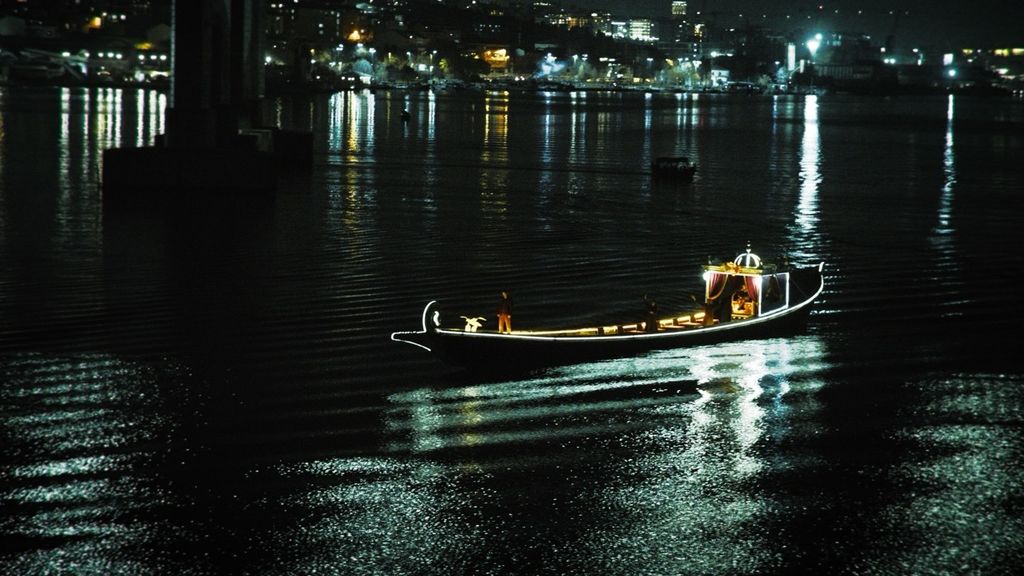
In the final and most impressive part of the film, we delve completely into Akin’s mind during a gondola ride. The ghostly world that shows itself to us there consists of his imagination and at the same time takes us on a journey into Istanbul’s past, which has been present throughout the film.
The film also makes Istanbul’s “forgotten” history visible when we find ourselves in Chalcedon—the original Greek name for what is now the Istanbul district of Kadiköy—where archaeological excavations are still ongoing. This is a history that extends far beyond Byzantium, reaching back to the archaic times of the pre-Christian Mithraism cult and the Anatolian mother goddess Kybele.
The film presents a complex dual structure in which the psychotic states of the protagonist create a second reality that simultaneously reflects the forgotten and hidden second reality of Istanbul itself. It is as if the centuries-long clash of cultures and religions in Istanbul’s history lives on in the protagonist’s mental illness. Just as the definition of mental health and normality is a social construct, history itself and its representation in a society is also a social construct. When we hear at the end that “sometimes the only thing that remains from a loss is a trace,” it is reminiscent of Walter Benjamin’s view of history, who wrote that the past carries a secret index through which it points to redemption and that in the voices we listen to, there is an echo of those now silent. Is the glowing red sunrise at the end of the film the redemption of Istanbul’s past – and at the same time Akin’s redemption from his illness or from the notion that his reality is an illness?
“New Dawn Fades” is a blend of a documentary look at the hidden and unknown sides of Istanbul and at the same time an insight into the inner world of a psychotic reality and its connection to religion. This combination gives the film a hybrid character: the real person Akin, who was originally supposed to be part of a documentary project, has disappeared, but a documentary aesthetic, sometimes reminiscent of “slow cinema”, remains palpable and merges with a fictional narrative about the loneliness of madness and an imagined esoteric history of Istanbul.
The idea that every place has a “memory” was already a central theme in Keltek’s documentary Koloni (2015), in which the present-day landscape of Cyprus was interwoven with the voices of a traumatic past. In his new film, it is the landscape of a city whose traumatic memories sometimes stare back at us like silent gazes from cemetery graves and ancient symbols that are still visible.
The film gains its political dimension by suggesting that the concept of a socially constructed normality and the desperate attempt to break free from this system also highlight the constructed nature of social and political reality.
Matthias Kyska

 Othon Cinema
Bir Şehrin Ruhuna ve Görünmeyen Tarihine Yolculuk – Othon Cinema için bir cevap yazın Cevabı iptal et