
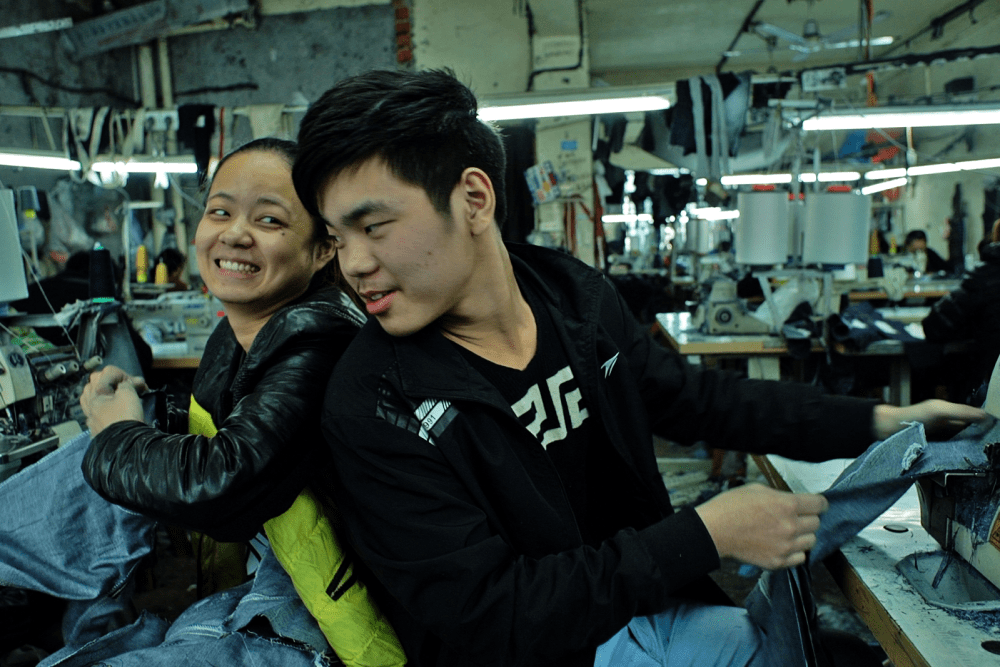
Wang Bing’s new documentary “Youth” not only impresses with its monumental production scale, but also with a two-year premiere that spans three festivals. Between 2014 and 2019, Bing filmed in the city of Zhili, near Shanghai, shooting 2,600 hours of video footage. From this material, three films emerged: “Youth (Spring)”, which premiered in Cannes in 2023, “Youth (Hard Times)”, which has now been shown in Locarno, and “Youth (Homecoming)”, which will be the only documentary in competition in Venice in September.
The “Youth” trilogy sheds light on the lives of young Chinese, mostly between the ages of twenty and thirty, who come from remote provinces to Zhili to work in one of the 18,000 workshops producing children’s clothing for the Chinese market. Nearly 300,000 young people work there, and the film follows dozens of them in their everyday lives in various workshops. The workers share small rooms in dilapidated dormitories located directly above the workshops, eliminating any separation between work and living space.
The workshops in Zhili are run by private owners and are not part of the Chinese state economy. Some of them allowed Wang Bing’s team to film there. In the state-controlled workshops and factories, where clothing is also produced for the international market, Wang Bing would never have been granted permission to film – the catastrophic working conditions that prevail there are left to our imagination.
In the first part of the trilogy, which bears the optimistic title “Spring”, we see not only the hard every day working life, but also occasional leisure activities and romantic relationships. In “Hard Times”, however, as the title suggests, increasingly difficult economic times begin.
There are not only the grueling, endless negotiations with the bosses, in which the workers have to beg for every cent increase in piecework wages, but also bosses who have run up huge debts, are beaten up by creditors or suddenly disappear, leaving the entire workforce of their workshop without pay. In one particularly dramatic scene, a worker is humiliated who urgently needs his wages but does not receive them because he has lost his pay book and is therefore unable to provide proof.
The workshops in Zhili are not large factories with assembly line production, but small rooms in which a few workers independently produce children’s clothing piece by piece with their sewing machines. Wages are not paid as a fixed monthly salary, but per piece produced. This leads to a toxic situation in which every worker “voluntarily” works until they are completely exhausted in order to produce as many items of clothing as possible.
The only noise is often the incessant rattling of the sewing machines and the Chinese music playing in some of the workshops. The floor is littered with textile scraps and each worker works as if on an island of fabric. In one of the most iconic moments, we see a workshop where all the workers have fallen asleep from exhaustion, clutching their fabrics as if their entire existence has been reduced to this small pile in the workshop.
“Youth” reveals not only the paradox of the Chinese economic system – the parallel existence of privately-run small businesses alongside the state-controlled large enterprises producing for the global market under the rule of the Chinese Communist Party – but also highlights an interesting development in the history of capitalism itself.
Michel Foucault coined the term “disciplinary society” to describe a form of society in which power is exercised through established institutions such as schools, prisons and factories. The individual is disciplined through surveillance and strict rules; authority is something external that acts upon the individual. Gilles Deleuze then introduced the term “control society” to describe a new form of society that emerged towards the end of the 20th century as a result of economic changes and technological developments. In contrast to the “disciplinary society”, surveillance is no longer external; authority is internalized as people monitor and adapt themselves.
We can clearly observe the transition from “disciplinary society” to “control society” by comparing Charlie Chaplin’s “Modern Times” (1936) and Wang Bing’s “Youth” (2023-2024). In Chaplin’s film, the entire work process is defined by the assembly line, and the worker becomes a cog in the machine (this dehumanizing situation is tragicomically portrayed by Chaplin in his unique acting style), while being constantly monitored by the factory manager. The Chinese workshops in Bing’s film are completely different: here, every worker is on his own with his sewing machine and textiles, determines his own pace of work and can come and go at any time without supervision. However, the insidious aspect of the “control society” is that through piece-rate payment, low prices per piece, and economic hardship, control is internalized, subjecting each worker to constant pressure.
In “Youth (Hard Times)”, we see dozens of workshops in Zhili that can hardly be distinguished from one another. However, it is a different story with the various workers in these workshops, the actual “protagonists”, whose lives we observe and who deal with their work and the associated pressure in very different ways. While some see the production of the garments as a fun game and competition and enjoy their time in the workshop with cigarettes and music, others buckle under the pressure of competition and are on the brink of giving up or even contemplating suicide.
Perhaps the “Youth” trilogy is not just a documentary about the textile industry in a Chinese city, but also a reflection of a large part of the young Chinese population. We hear one worker say that the only meaning in their life is “earn more, spend more”, while another points out: “What is the meaning of money if there are no rights in this country?”
After almost four hours of seeing nothing but the stifling workshops, the tiny rooms of the dormitories and the narrow, colorless streets of Zhili overflowing with garbage, it almost feels like a relief to see the young people returning home to their home provinces for the Chinese New Year at the end – for the first time we see green landscapes and open countryside. While the film ends for us, it is only a brief respite for the young workers before they start the 30-hour journey back to Zhili after the holidays and the hard everyday life in the workshops continues.
Matthias Kyska

 Othon Cinema
Umutsuz Çin Gençliğinin Bir Panoraması – Othon Cinema için bir cevap yazın Cevabı iptal et